Sânziene Night in Borșa, photographed for the story, not the poster.
On 23 June we documented Sânziene Night in Borșa — not for the event’s organiser, but for a RomâniaFrumoasă reportage. It sounds administrative. In practice it changed almost every frame: what goes in, what stays around it, and what is not photographed at all.

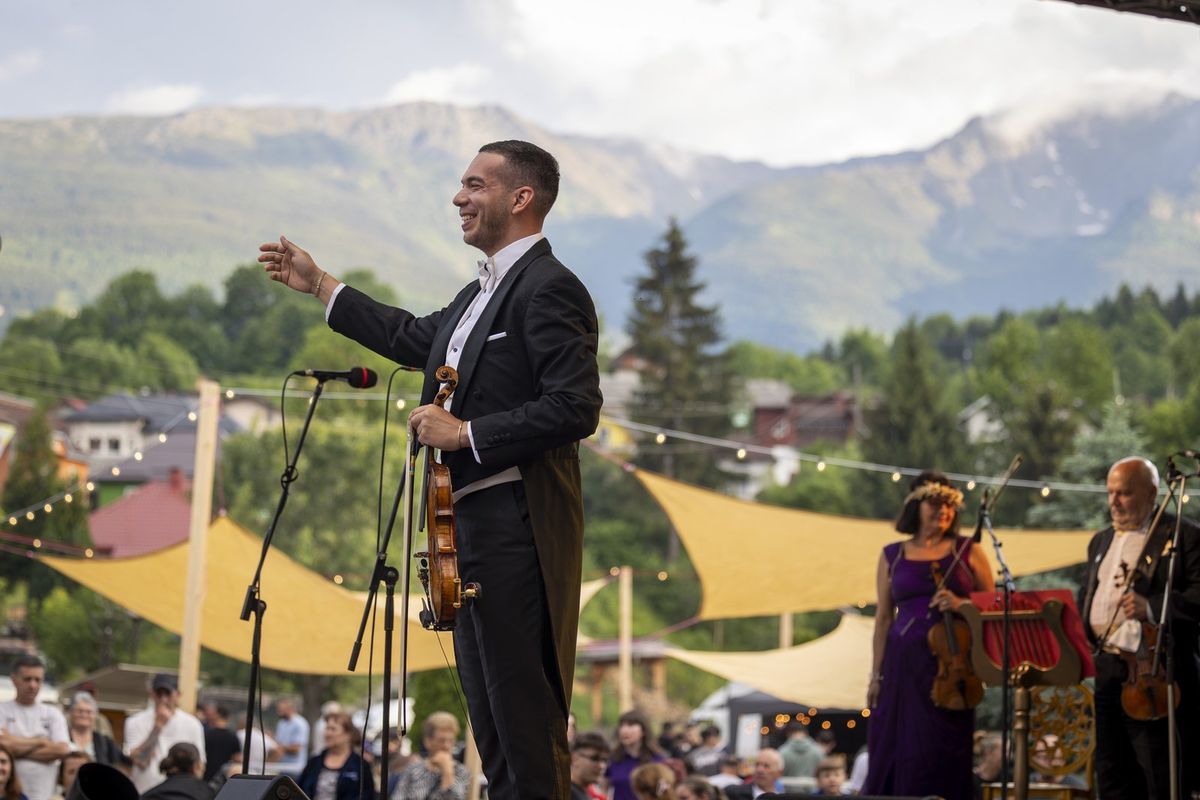
Borșa, 23 June 2026. The first frame delivered from that evening is timestamped 20:02: the stage in the middle of town, the Rodna Mountains behind it, at the start of the concert “Simfonia Iubirii” — the Symphony of Love. The last one is 23:11 — the embers of a pyre of torches, on the tarmac of the main street, closed to traffic for Sânziene, the Romanian midsummer feast.
The event was organised by the town hall and the house of culture in Borșa, with the local ensembles, as part of the “Nopți de Sânziene” festival. We were not working for them. We photographed and filmed for RomâniaFrumoasă, the cultural platform edited by the agency’s founder — for a reportage about the Sânziene fire, not for the festival’s communication.
The difference sounds administrative: someone else receives the files. In practice, it changed nearly every decision of that evening.
What the organiser would have asked for
An organiser needs a particular set of images, and it is a legitimate set. The full stage and the headline act. A large audience, as proof that the event drew a crowd. The officials, the partners, possibly the sponsor board. Frames that work for next year’s poster, for the report to the funders, for the press.
Had that been the brief, we would have delivered all of it. The brief in Borșa was a different one: a reportage with a thesis. And a thesis is not illustrated. It is demonstrated.
A shot list written as a list of claims
The reportage started from something verifiable: the Sânziene fire is not a general Romanian custom but a northern one, and in the Vișeu valley, where Borșa lies, it is the best documented in the country. The earliest written attestation dates from 1866. The published text cites 13 sources.
For the photographer, that turned the shot list into a list of claims. Each one needed an image to hold it up:
- The pyre is built from torches, not from firewood. So a close frame on the construction, as close as the heat allowed.
- The torches are made the old way — split fir laths, tow, resin, bound with wire. So the detail, not only the flame.
- The costume is the Vișeu valley’s. So whole costumes, from hat to opinci, not only faces lit by the fire.
- The custom belongs to today’s community, not to a re-enactment. So what surrounds it, too: the churros van, the raised phones, the gendarmes with their backs to the fire.
The last point is the one an organiser’s brief would have cut first. The churros van beside the pyre does not look good on a poster. In a reportage it tells the truth about Borșa in 2026: an old custom kept alive in the middle of a town that lives in the present.
The frame nobody would have asked for
At 23:11 the pyre had collapsed into embers. What was left on the tarmac were the pale ends of the torches, charred at the tips — and, among them, the pieces of wire that had held them together.
Photographically there is nothing spectacular about it. For an organiser it would have been useless: the fire is over, people are going home. For the reportage it was essential. The ethnographer Pamfil Bilțiu describes how a torch is made — dry fir, resin, splinters — “then it is bound with a wire, so the fire does not jump when it burns”. The wire in the embers ties the 2026 fire to the ethnographer’s description. It is the evidence, not the decor.
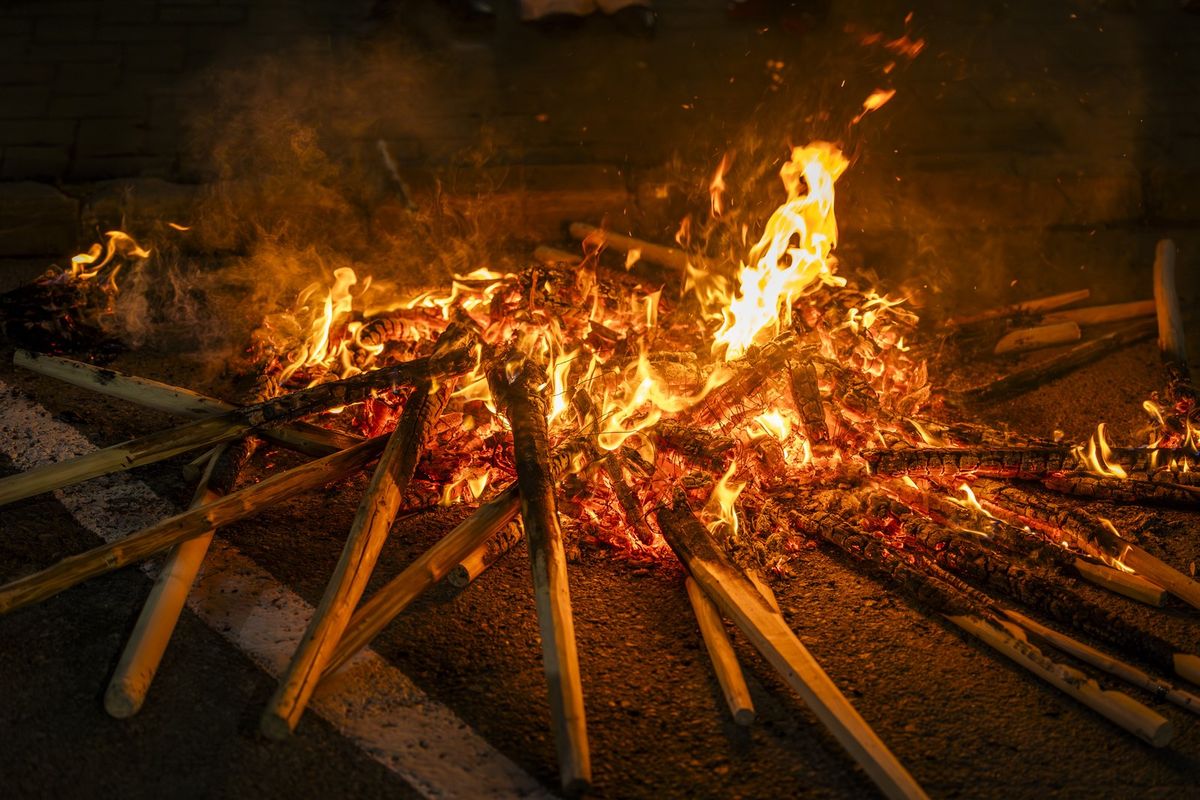
A poster needs the flame. A reportage needs the wire in the embers as well.
What we did not photograph
Towards the end, the reportage has a section that rarely appears in event material: what we did not see. Spinning the torches overhead — the classic gesture of the custom, described by ethnographers — is not done in the town centre: it is too dangerous in a crowd. Neither is jumping over the fire.
A torch spun through the night would have been the perfect cover image. It did not happen, so it is not in the gallery either — and the text says so plainly, so that no reader goes looking for something that never took place.
Other frames are missing from this article alone. The moment of the concert, in the reportage, is a little girl in the audience reaching for the bow of the violinist who had come down among the chairs. There, she is part of the story. Here we do not show her: on an agency’s website, the same photograph becomes promotional material. A different context, a different decision — and the same for every child in the fire gallery.
Technical: one evening, one lens
The file metadata tells the rest. All 91 delivered photographs were taken with the same body and the same lens, a 70–200 mm, at f/2.8 from the first frame to the last, with no flash.
- At the concert: 49 frames, between 20:02 and 22:47, with a median focal length of 111 mm. The photographer stands in the audience, not on stage. The stage was lit, so sensitivity stayed low: half the frames at ISO 400 or below.
- At the fire: 42 frames in fifteen minutes, between 22:56 and 23:11. Thirty-nine of them at ISO 6400, all at 1/250 of a second — enough to freeze the dancers and the flames by firelight alone.
What came out of it
- The reportage “Borșa — The Fire That Burns Once a Year”, published by RomâniaFrumoasă on 3 July, ten days after the event, in Romanian, English and Hungarian.
- 573 frames from that evening, from which 91 photographs were processed for the web, in two galleries: 49 from the concert, 42 from the fire.
- A film of 11 minutes and 50 seconds.
- A social package: a 10-frame carousel, 7 stories, and covers for YouTube and TikTok.
The text and the historical research are the newsroom’s. On RomâniaFrumoasă the photographs are credited to AdiCoco.com: the photographer that evening was the agency’s founder.
Three questions before an event
If you are organising a festival, a launch or a gala, the first question for whoever documents it is not what camera they own. It is who the photographs are for.
- Who uses them, and where? Next year’s poster, the report to the funders and the press release call for different frames. A photographer who does not know which ones they are taking delivers a mixture that serves none of them well.
- What do they have to prove? If you say the event drew a whole town, you need the frame that shows it. If you say it is a local tradition, you need the detail that proves it — not only the flame.
- What stays in frame even though it is not pretty? The churros, the cables, the phones. Sometimes they have to go. Sometimes they are the story. That decision is made beforehand, not at selection.
One clarification, so that nothing is left ambiguous: RomâniaFrumoasă is not a channel we offer clients. What the platform publishes is the newsroom’s decision, not a contract with the agency. What carries over from one project to the next is the discipline: primary-source research, fact-checking, and a shot list written as a list of claims.
The organiser had the fire that evening. The reportage needed what remains after it as well. Who you photograph for decides what you photograph — including at 23:11, when people are leaving and all that is left on the tarmac is the embers.


